The discussion that follows grew out of a series of encounters and exchanges over the past year around the history and present relevance of proletarian internationalism. What gave these discussions particular urgency was the disturbing resurgence of campism within radical –and increasingly not-so-radical– milieus: the renewed tendency to subordinate the critique of states, war and capitalist domination to support for the “lesser evil”, for a national camp on the grounds of the real oppression of the population it claims to represent, or for forces identified with “resistance to imperialism”. From Ukraine to West Asia and Southeast Asia, the pressure to choose between competing imperialist or national camps has once again become a central political problem.
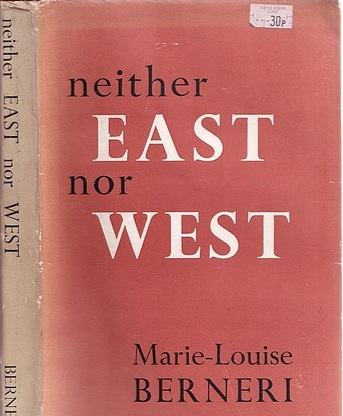
A number of discussions in Paris in the spring of 2026 helped give more concrete form to these concerns. One concerned an ongoing translation of Marie-Louise Berneri’s texts from War Commentary for Anarchism and Freedom, which had been collected in Neither East Nor West.[1] Another concerned the recently deceased Henri Simon –the centenarian council communist and former member of Socialisme ou Barbarie– and his relationship with Henry Chazé, a key figure in both Union Communiste and the French Fraction of the International Communist Left.
These encounters pointed beyond any single organization or political tradition towards a broader history of proletarian internationalism, developed across both communist and anarchist currents in opposition to capitalist war and to the political forms through which proletarians have been repeatedly subordinated to it: anti-fascist class collaboration, national “liberation”, “just national wars”, and alignment with an imperialist camp presented as “anti-imperialist”. But recovering this history also raises a more difficult question than simply restating an internationalist, or “third-camp”, position: why did this position remain, in almost every case after 1920, a minority position within the class?
The problem was not only numerical weakness. The groups that maintained an internationalist position rarely connected, except briefly and partially, with the mass movements of the class they addressed. They were small, clandestine, persecuted, theoretically sharp and organizationally fragile. They wrote for a class that was, in the overwhelming majority of cases, marching in the opposite direction – under national flags, anti-fascist fronts, or liberation armies.
The 1917–1920 revolutionary wave is the obvious exception: the moment when a mass reversal of standpoint actually occurred. Between 1917 and 1920 – in Russia, Germany, Hungary, parts of Italy, and the mutinies that shook the Entente armies toward the end of the war– the internationalist refusal of war briefly became a material force. Soldiers fraternized across the trenches and refused to fight, workers refused to produce and formed councils. Lenin’s formula “turn the imperialist war into civil war” was not just a slogan; it described something actually happening, driven not primarily by Bolshevik organization but by the exhaustion, rage, and political radicalization of millions sent to die for interests visibly not their own. What made that connection possible was not primarily the correctness of the political line. It was the material exhaustion of years in the trenches, combined with a pre-existing organizational density in the working class that could be reactivated in a different direction. By 1921 or 1922, the revolutionary wave had been defeated almost everywhere, and when the next major cycle of wars arrived, in the 1930s and 1940s, the internationalist position was again largely confined to small minorities. Why the connection between war-weariness, class organization, and revolutionary internationalism happened then and why it has not happened again in the same way is the most important question this experience poses – and one we want to keep open throughout the discussion.
The starting point of proletarian internationalism is the refusal of the recurring pressure placed on proletarians to choose between state camps – a refusal grounded in the recognition that war is not an aberration from the normal functioning of capitalism but its condensation: inter-state competition over markets, territories and labour, reorganizing production through destruction and forcing the discipline that peacetime cannot always impose. This pressure does not appear only as patriotism or supremacist nationalism. It takes the form of anti-fascism, national liberation, defence of democracy, anti-imperialism, resistance to occupation, or support for the lesser evil. In each case, proletarian autonomy is abandoned in the name of a supposedly more urgent political task.
This tendency, often named as the proletarian “third camp” or “third choice”, refused the logic of the “lesser evil” between state machines. A weaker capitalism in conflict with a stronger one remains capitalism. A dominated or attacked state does not cease to organize exploitation, discipline labour, police populations and bind classes together under the form of the nation. The nation is one of the political forms through which class antagonism is displaced: a society divided by exploitation appears as a common community of citizens, bound by a shared interest, a shared fate, and, in war, a shared enemy. The defeat of one imperialist bloc merely changes the balance of forces within global competition; it is neither a victory of the working class nor a step towards its self-abolition. It is not even a challenge to imperialism per se. Democratic war machines, national liberation movements and authoritarian or theocratic opponents of the West all demand, in different languages, the same renunciation: the suspension of autonomous class struggle in the name of a higher political necessity.
The political clarity of the internationalist current did not come from sectarianism, nor from isolation as such. It came from the fact that these militants were forced, by the reactionary development of the workers’ movement itself, to break with the forms through which that movement was being incorporated into the state, the nation and the war effort. Their clarity was therefore forged through successive ruptures: with social patriotism in 1914, with Stalinism, with the defence of the USSR, with anti-fascist class collaboration, with national liberation as capitalist modernization and state-building, and with every idea that proletarian emancipation could pass through the victory of a state or imperialist camp.
The minority condition of explicit internationalist groups should not be interpreted as absence of resistance to war. War mobilization is never purely ideological or voluntary. It requires discipline, coercion, fear, propaganda, legal compulsion and the policing of populations. Draft evasion, desertion, military disobedience, refusal of war production, social exhaustion, strikes and hostility to the state can all weaken the war effort without becoming consciously and explicitly internationalist. The political question is how such refusals can be transformed into a class negation of capitalist war and all national states rather than being absorbed by pacifism, democratic humanitarianism, nationalism or the rival camp.
The texts collected in our publication should be read not as an invariant doctrine, but as situated attempts to formulate a class response to moments when proletarians were pressed into national, anti-fascist, democratic or anti-imperialist mobilizations. Each case returns to the same problem from a different historical angle.
The first formulation appears with particular clarity in the Japanese anarchist response to the invasion of Manchuria in 1931. The Japanese Libertarian Federation wrote from inside the attacking imperialist country. Its first target was the Japanese state, its army, its capitalist class and the patriotic language through which the invasion was justified. The fatherland, in this text, is not a community of the exploited and their exploiters. It is the political form through which the poor are asked to endure hunger, cold and death while the ruling class gains profit and power.
What matters here is that the denunciation of Japanese imperialism does not transform into support for the opposing national camp. The Japanese Libertarian Federation asks who would benefit if Japanese influence were removed from China through a victory of the national liberation movement. Its answer is: not the Chinese workers and peasants as an autonomous social force, but the rising Chinese bourgeoisie and the foreign capitals competing with Japan. This was an early form of the double refusal developed more sharply in the later texts of our publication.
The text specifically references Kropotkin’s 1914 stance – supporting the Entente because he considered German militarism the greater danger. The Japanese anarchists treated this as a fatal error. Once one imperialism is considered sufficiently worse to justify support for the other, internationalism has already been dissolved into the logic of inter-state war. The problem is the acceptance of a framework in which proletarians are asked to assess which ruling class should defeat another.
The Union Communiste developed the same question in a more systematic communist form during the Sino-Japanese War of 1937. The Spanish experience had already established its framework: the Popular Front had shown that “critical” support for the democratic bourgeoisie meant reinforcing the apparatus that crushed the Barcelona workers in May 1937 and eliminated forces – the POUM and the most radical anarchist currents – that could not be subordinated to the national-democratic line. Its polemic against Trotsky is central. Trotsky argued that China, as a semi-colonial country attacked by Japan, was waging a progressive national war that revolutionaries should support while maintaining political independence from Chiang Kai-shek.
The Union Communiste rejected this distinction between military support and political independence. The issue was not which side had been attacked. National defence is organized through the bourgeois state, its army and its political leadership; support for it therefore means strengthening the apparatus through which the working class is subordinated. In China, this meant strengthening the Kuomintang’s military and bureaucratic power – the same bourgeois force that had crushed the workers’ revolution of 1926–27. A state apparatus built in the name of anti-imperialist war does not become harmless because the support given to it is called critical. The discipline of national war transforms “critical support” into practical participation in the national effort.
During the Second World War, the same issue reappeared in the form of anti-fascism and the defence of the Soviet Union. This mass alignment was the culmination of the political disarmament of the proletariat during the interwar period, where the institutional integration of the working class into the democratic state by social democracy and the Stalinist policy of the Popular Fronts, which transformed the class struggle into an antifascist defense of bourgeois democracy, had already eroded any ground for class autonomy. For most of the left, the war was framed as a struggle between fascism and democracy, or a war where the USSR had to be defended despite Stalinism. By this point the internationalist groups had broken not only with Stalinism but with the Trotskyist position that Russia as a degenerated workers’ state required defence against imperialism – a logic that ultimately contributed to the subordination of the proletarian masses around the world to the Allied imperialist camp. The internationalist minorities in occupied Europe tried to maintain another position. The Revolutionären Kommunisten Deutschlands (RKD), the Groupe Révolutionnaire Prolétarien/Union des Communistes Internationalistes (GRP/UCI), left communist fractions and the anarchist network around André Arru operating from Marseille and Toulouse, opposed Nazism and German occupation, but also Allied imperialism, Stalinism, national resistance fronts based on class collaboration, and the restoration of capitalist order under the name of Liberation.
These groups produced illegal leaflets in German and French, addressed German soldiers as proletarians in uniform rather than mere instruments of the Nazi state, and called for fraternization, desertion, refusal of discipline and struggle against all states. They attempted to shatter the imposed national cohesion of the war by politically intervening within the ranks of the army itself. And certainly, this was not a denial of the reality of German occupation or Nazi terror; it was a refusal to translate that reality into support for the Allied camp, the patriotic resistance or the Soviet state. Some militants were arrested, deported or killed. Karl Fischer of the RKD survived Nazi repression only to be kidnapped after the war by the Soviet apparatus and sent to the Gulag.
This tendency was not absent from the Greek context. The current around Aghis Stinas –through its successive organizational forms during the Occupation– maintained an internationalist position inside occupied Greece, against both the Axis and the Allied camp, and against the EAM/ELAS line of national unity which it identified as the subordination of the working class to Allied imperialism. The internationalist position was held not only in the metropolitan centers of Western Europe but also in a country under conditions of extreme repression, where the pressure toward national unity was among the most intense anywhere.[2]
In the context of Italy, the March 1943 strikes in Turin, Milan and the northern industrial centres showed that a real working-class rupture could emerge inside the aggressor state, driven by hunger, exhaustion and hatred of fascist discipline. But this rupture was later absorbed into the framework of anti-fascist national liberation, above all through PCI and CLN, the National Liberation cross-class coalition, uniting Communists, Christian Democrats and even monarchists. The texts in our collection written around the Italian conjuncture from groups in Britain and occupied France, without any communication between them register this situation almost identically. Berneri’s texts refuse to identify Allied bombing with liberation and juxtapose them with workers’ strikes and sabotage in Italy to expose them as a means of imposing capitalist “order”; the texts of the communist left attack the same process as a preventive counter-revolution aimed at the restoration of capitalist order through antifascism and nationalism. What the national liberation framework suppressed was the possibility that workers’ revolt against fascism and war might have exceeded the limits of anti-fascist state reconstruction and transform into class war.
In France, the “liberation” of Paris in 1944 briefly posed the question of whether these internationalist minorities could connect with a broader working-class movement. GRP/UCI and RKD militants participated in the strike committee at Renault. For a short moment, the expectation of a new revolutionary wave was not absurd. But the opening closed quickly. Stalinist influence in the workplaces, the return of state order and the stabilization brought by the Allied armies limited the possibilities. Groups that had preserved an internationalist position through years of repression lacked the roots or scale to shape the situation when it briefly opened. Theoretical clarity alone cannot produce a wider force; that depends on the level of class organization, the disintegration of military discipline, the weakening of state legitimacy, and the possibility of connecting isolated refusals into a common movement.
War Commentary in Britain operated not under German occupation but inside one of the victorious democratic imperialist states. Internationalism is not tested only under dictatorship or occupation; it is also tested inside democracy, when the democratic state demands labour discipline, censorship, military obedience and silence in the name of the anti-fascist war effort. The anarchists around War Commentary argued that Britain was not fighting for freedom against fascism. It was an imperial state defending colonies, markets, trade routes and its global position. The anti-fascist war was a capitalist war. The demand that workers support the war effort meant their incorporation into the discipline of the state.
This is why their attempts to reach soldiers mattered. War Commentary addressed the troops not as parts of a supposedly neutral national institution, but as a mass of workers in uniform, subject to discipline yet capable of discussion, disaffection and revolt. Through its soldiers’ correspondence, the Forces Newsletter and references to older mutinies and soldiers’ councils, the publication sought to open communication within the armed forces themselves. Their prosecution in 1945, for conspiracy to cause disaffection in the armed forces, showed the limits of democratic tolerance at the very moment when the war was ending and demobilization threatened to turn soldiers back into a volatile social force. The danger was not an imminent military revolt, but the possibility that returning soldiers –workers in uniform, soon to re-enter workplaces, streets and housing struggles[3]– might carry disaffection back into civilian life. War Commentary’s attempt to address them as thinking proletarians rather than obedient military subjects therefore touched a real fault line in the transition from war to postwar order.
The colonial question, however, exposed a limit in this milieu. Albert Meltzer’s 1942 text on national independence still allowed that national independence struggles could, under certain conditions, acquire progressive content. This points to a persistent difficulty: how to oppose one’s own imperial state and support the struggles of colonized people without politically endorsing nationalist movements that will simply reproduce class domination under another flag.
In the colonial environment per se, Ngo Van’s account of Vietnam in the immediate post-WWII period is of great importance making this difficulty brutally concrete. His perspective came from the immediate experience of French colonialism, Japanese occupation, the collapse of Japanese authority, British intervention, the return of the French and the rise of the Viet Minh. In 1945, there was a brief moment during the power vacuum that was created after the departure of the Japanese when workers and poor peasants acted independently. In the Hongay-Campha mines, workers took control of production and formed councils. In Saigon, independent committees and internationalist militants of the left opposition raised demands for arms, workers’ control, land to the peasants and formed popular committees. These movements were crushed not only by colonial forces but also by the Viet Minh. The assassination of militants of the left opposition was not an accidental excess. It expressed the logic of national liberation as state-building: forces that could not be subordinated to the new national authority had to be eliminated.
Writing later in 1968, during the Vietnam War, Ngo Van did not minimize the violence of US imperialism, but he refused to let that violence become a reason to support Ho Chi Minh’s state. His position was that Vietnamese workers and peasants had nothing to gain from either American capitalism or Northern Vietnam state capitalism. National liberation was identified as a change of bosses. The colonial administration may depart, but exploitation is reorganized by a national bureaucracy, the party-state and the emergent domestic ruling class. His insight was proved completely correct.
In Vietnam, the danger that support for a national war would lead to the establishment of a state capitalist regime was no longer a theoretical anticipation; it had already become historical experience. The national movement had shown that, in order to monopolize state power, it would destroy autonomous proletarian and peasant initiatives. Ngo Van’s critique of national liberation therefore did not come from indifference to colonial domination, but from the experience of a struggle in which anti-colonial war had been turned into the formation of a new state power against the very social forces it claimed to represent.
The Vietnam War in the 1960s casts a different light on the analysis of anti-war mobilizations and soldiers’ insubordination. The American military failure was not simply a battlefield defeat, but the result of widespread class insubordination. Resistance inside the army and domestic society – desertion, underground GI press, refusals of combat, fragging, breakdowns of discipline, and the exhaustion of a drafted working class – crippled the capacity of the American state to continue the war. This resistance did not crystallize into a proletarian internationalist movement; it remained largely pacifist, democratic, generally anti-imperialist. Yet it shows that broader refusals of war can become materially significant even when explicit “third camp” internationalism remains minoritarian. The problem is how such refusals can be clarified and connected without being absorbed by liberal pacifism, support for the rival camp, or an anti-imperialism that leaves the class content of the opposing forces unexamined.
Relevant to that and contrary to the uncritical positions on national liberation prevalent today, the 1976 Paris manifesto by Arab and Israeli communists, published in the journal Khamsin, develops the simultaneous critique of Zionism, the Israeli state, the Arab regimes, Palestinian national organizations and the imperialist forces active in the region. The Israeli state is analysed as a Zionist capitalist state based on mass displacement, military domination and brutal violence against the Palestinian population as well as the incorporation of Jewish workers into national defence and the nationalist and expansionary Zionist project. Today, the trajectory of the militarism they critiqued has escalated into genocide. At the same time, Israeli Jewish workers are not reduced to a simple extension of the state. Class conflict, wildcat strikes, internal hierarchies and social disaffection at that time were still a reality within Israeli society and remained politically relevant. The balance of class forces is different today and reactionary nationalist ideologies weigh much more heavily – not only in Israel, but across the region and internationally.
The manifesto’s critique of Palestinian nationalism is not secondary to its critique of Zionism. It rejects both the state-oriented strategy of the PLO and the rejectionist alternative that opposed any compromise in the name of total national liberation and the destruction of the state of Israel. These positions differed tactically, but they shared the same horizon: the organization of Palestinian proletarians as a national people represented by political and military leaderships. Emancipation cannot be equated with the construction of a state, the victory of a national army, or the diplomatic recognition of a national leadership. The position held by the comrades was clear: a Palestinian state might remove one alibi of Arab nationalism and place Palestinian workers face to face with their own ruling class; it would not constitute their emancipation.
Peace between states, or between state and quasi-state actors, is not the opposite of war. It is a new organization of the same reality: borders, security arrangements, police measures, diplomatic recognition, population management, reconstruction and new forms of incorporation into national economies. In this sense, peace continues the class content of war by other means. It does not abolish the forces that organized the conflict; it can stabilize their relation and redistribute their roles.
This dynamic applies to the present without anachronism. Temporary settlements, ceasefires, prisoner or hostage exchanges, reconstruction mechanisms and security guarantees may become acceptable to actors such as Hamas, Iran, Qatar, Israel and the United States, each for its own reasons and within its own strategy. But such arrangements cannot be equated with the interests of Palestinian proletarians. They regulate the conditions under which Palestinians remain governed, policed, displaced, contained, employed, unemployed, made dependent on aid, or even killed en masse.
The last text of our compilation, Arya Zahedi’s text on Iran brings the critique of anti-imperialist campism into the present. The conflict of the state of Iran with United States, Israel or the West is again treated by such “anti-imperialists” as sufficient reason to set aside its class character, its brutal repression of class and social struggles and its role in capitalist domination in West Asia. The Islamic Republic uses external conflict to violently enforce internal discipline: to suppress strikes, crush the women’s movement, impose austerity, police morality, repress minorities and present social struggle as treason in a moment of national emergency. This is not unique to Iran. Every state uses external danger to demand internal unity. What is specific today is that parts of the international left accept this logic when the state in question confronts the United States, Israel or the West –as the war effort of the state is rebranded as “resistance”– without the fig leaf of the state’s socialist character, or a ‘third way’ to socialism, as in the past.
The result is predictable: workers, women, migrants, minorities and prisoners who fight the regime disappear from view when bombs fall. The war effort of the state is rebranded as “resistance”; those it exploits and represses become secondary. Conflict with a stronger imperialism does not transform a state into an agent of emancipation. It merely makes the state more effective internally, because dissent can be criminalized as betrayal.
This problem extends beyond the old left: Stalinism, social democracy, patriotic anti-fascism or classic anti-imperialist campism. It infects currents presenting themselves as a radical critique of traditional Marxism. These currents should not be collapsed into one another. Communisation theory, value critique, Postone-influenced Marxism, the Frankfurt School inheritance and anti-German politics have different histories and often lead to opposed political conclusions. Yet some versions of these currents share a common tendency: the proletariat appears so completely integrated into capital that it can no longer be thought as the contradictory subject of communist transformation.
The approach of Théorie Communiste is more subtle. TC does not simply reproduce a theory of the proletariat’s total subsumption into capital. But it likewise refuses to locate communist overcoming in the possible constitution of the working class as a class for itself: any positive autonomy or self-affirmation of the proletariat remains, for TC, an affirmation of one pole of the capital relation and therefore a limit to be overcome. The problem is that once autonomous class activity is reduced to such a limit, the passage beyond the capital relation can no longer arise through the development and generalization of that activity itself. It is instead located structurally in the transformation of the class relation: in the growing superfluity of labour for valorization and in the widening separation between the reproduction of proletarians and the valorization of their labour-power. The abolition of the proletariat thus tends to appear less as the possible outcome of its contradictory self-activity than as the result of a contradiction produced by capital itself, which eventually makes class belonging into an external constraint that is then abolished by the communising measures of a population whose affirmation as a class has been rendered impossible.
Our critique of these positions is not about retreating to a nostalgic, workerist cult of labour and the factory. The communist horizon is not the self-affirmation of the proletariat as a class within capitalism, but the abolition of capital as social relation and therefore of the proletariat as such. The problem begins when the necessary critique of proletarian self-affirmation becomes a theoretical foreclosure of the class’s capacity to transform itself through its own struggles. If the proletariat is understood only as fully subsumed into capital, integrated into a “totally administered society” or even nothing beyond a pole of the capital relation then the possibility of rupture tends to be displaced elsewhere. Sometimes it is transferred to surplus populations, migrants, racialized subjects, the absolutely excluded or an undefined figure of resistance such as the “barbarians”. Sometimes it is transferred to national liberation movements whose class content remains unexamined. In other cases, especially in some anti-German milieus, the displacement moves in the opposite direction: towards the defence of an existing state, that is Israel, as a supposed barrier against antisemitic barbarism.
The anti-German trajectory is a case where the initial insight already contained the germs of its later development. There had indeed been a tendency in parts of the German left to treat antisemitism and the Holocaust as if naming fascism, capitalism or imperialism in general were already enough to grasp their determinate historical form. But the anti-Germans answered this by separating that historical form from the class relation, the capitalist state and the material history of imperialist violence. The result was not a dialectical account of antisemitism as a specific moment within the capitalist totality, but the elevation of this particularity into a political exception. Antisemitism is not simply one racism among others, nor is the Holocaust simply one state massacre among others; but neither can be understood as an underived singularity detached from the capitalist social totality that produced the modern state, racialization, imperial competition and exterminatory nationalism. The anti-German error was therefore not only the later support for Israel, the United States or NATO. It was already present in the form of the correction itself: instead of deriving particularity through the totality, it increasingly opposed particularity to totality.
From there, Israel was stripped of its reality as a capitalist state with its own class relations, nationalist violence and geopolitical function, and elevated into the privileged bearer of historical memory and anti-fascist reason. Defending Israel seamlessly slid into apologetics for US and NATO power, recoded as the defense of civilization against antisemitic barbarism. This is not a minor deviation from the original critique. It is its reductio ad absurdum: the critical theory of total integration, taken to its endpoint, producing uncritical support for existing power. That trajectory deserves to be named and described precisely because it shows how completely the displacement of emancipation outside the class relation can invert the original political intention.
The political consequences of TC’s conception become clearer in its exchange with Minassian over Gaza.[4] In its analysis of Gaza, TC correctly recognizes the fragmentation of the Palestinian proletariat and its production as a “surplus population”. The problem lies in what it understands by autonomous class activity. For TC, proletarian self-organization remains an affirmation of the class within the capital relation and therefore a limit to be overcome. Since self-organization means the class acting strictly as such, it can itself take national or other forms of incorporation. The distinction between self-organization and class autonomy is thereby blurred. Autonomy no longer names a tendency within struggle through which proletarians come into conflict with the forms that organize them as a class of capital, but is treated as the search for a supposedly pure class activity separate from those determinations. Hence the charge of “conceptual purity” against attempts to identify autonomous tendencies within the struggles of the Palestinian population. The result is paradoxical: because nationalist self-organization can be accepted as the actual form of proletarian struggle, while distinguishing the antagonisms that cut across it is suspected of imposing an abstract purity, the “available banners” of national or religious proto-states tend to become the practically inescapable forms of struggle. What is thereby deprived of independent political significance are precisely the real struggles and material frictions directed against Hamas as a governing bureaucracy.
This has consequences beyond TC’s own analysis. It converges politically with a broader “anti-imperialist” left that violently polices this national boundary, preemptively smearing the very prospect of solidarity across national lines –or any attempt to frame the conflict in class rather than national terms– as an expression of a ‘colonialist mindset’ or of ‘liberal Zionism’. Ultimately, this approach treats the capitalist apparatus of national liberation as an insurmountable limit of the struggle, surrendering the internationalist position to the logic of the lesser evil.
Support for Palestinian national resistance and support for the Israeli state are obviously different political outcomes. Yet beneath these obviously different political outcomes lies a related theoretical displacement: emancipation is no longer located in the contradictory struggles of the proletariat against its own capitalist constitution. Instead, transformative activity tends to be sought either in the determinations under which the class is presently organized, in other privileged figures of negativity, or outside proletarian self-activity altogether – in the oppressed nation, the excluded subject, the victimized identity, abstract negativity, or a state that claims to defend civilization against barbarism.
Our starting point is different. It does not require a naive belief in a ready-made revolutionary subject. The proletariat is not revolutionary because it is pure, external to capital or already conscious of its task. It matters because it is produced by capital, disciplined by capital, and yet capable, in struggle, of interrupting the reproduction of the relation that constitutes it. The problem cannot be solved by allowing the proletariat’s integration into capital to exhaust the political meaning of its struggles. The point is not to replace the old affirmative worker-subject with another purified figure of negativity –the so called “abject”, surplus populations, or a structural mechanism presumed to produce rupture by itself– but to work through the contradictory refusals that emerge within capitalist social relations themselves.
This brings us back to Vietnam. The history of the Vietnam War is important not because it offers a replicable model, but because it maps the terrain where internationalist intervention must operate. War refusal almost always begins in confused, partial, and non-programmatic forms. Yet it is precisely this space of spontaneous resistance that provides the material basis for a proletarian internationalist rupture with the national war machine.
Also this brings us back to the question with which we began: why has such spontaneous resistance rarely crystallized into a mass rupture comparable to that between 1917 and 1920? To answer it, we must look beyond ideological defeat. The absence of a comparable internationalist wave in the following decades was the result of a profound structural shift. The material “organizational density” that enabled mutinies, fraternization, and the emergence of the council form was systematically dismantled. On one hand, autonomous forms of class organization were physically crushed or institutionally integrated into the state apparatus through trade union bureaucratization, social democracy, and Stalinism. On the other hand, the composition of the class itself has been radically transformed: successive waves of capitalist restructuring, deindustrialization, and the fragmentation of compact working-class communities dissolved the old material basis of collective action. Therefore, the problem today is not how to simply revive the organizational models of 1917, but how the contemporary refusal of war can acquire a class content and become a material force within the structurally fragmented reality of today’s proletariat.
European rearmament frames this problem urgently today. Governments speak the language of preparedness and national defence, but the willingness to fight is not simply available to the state. It has to be produced through fear, discipline, propaganda, borders, conscription laws and punishment. The political will to fight –in the sense of mass voluntary identification with national military projects– is remarkably weak across Europe today. Ukraine is the sharpest index of this: forced conscription, rampant draft evasion, and the internal social friction generated by the cost of the war entirely contradict the myth of a population uniformly united behind the flag. This does not mean that Ukrainian workers and soldiers have adopted an internationalist proletarian position, at least not in any organized sense. However, the gap between what the state needs and what the people are willing to endure is a real fracture – the kind of fracture we have to work within.
Ultimately, the history we are discussing leads to a practical problem rather than a closed conclusion: under what conditions can the internationalist position intervene in the real fractures of war mobilization and help turn them into a class rupture with the state, the nation and the capitalist organization of life? These fractures are not immediately revolutionary and can be absorbed by pacifism or campism– a tendency visible, for example, in the contested political meaning of port workers’ mobilizations against arms shipments. But without them, the “third camp” remains an abstract formula.
Antithesi, (21 June – 11 August 2026)
Texts of the published collection
Japanese Libertarian Federation, “What To Do About War?”, Jiyu Rengo Shinbun, no. 64, November 1931; originally published in Esperanto; English translation by John Crump, reprinted in Anarchist Opposition to War, Seattle: Charlatan Stew, 1995. (https://theanarchistlibrary.org/library/japanese-libertarian-federation-what-to-do-about-war)
Union Communiste, “En face le conflit sino-japonais”, L’Internationale, no. 31, 3 October 1937. (https://archivesautonomies.org/spip.php?article5995)
War Commentary editorial group, “War and Resistance”, War Commentary, vol. 1, no. 1, November 1939. (https://archivesautonomies.org/spip.php?article6258)
War Commentary editorial group, “The Third Choice”, War Commentary, vol. 1, no. 10, August 1940. (https://archivesautonomies.org/spip.php?article6289)
Les Communistes Révolutionnaires / Die Revolutionären Kommunisten, “Ouvriers! Soldats! / Arbeiter! Soldaten!”, bilingual leaflet in French and German, July 1942. (https://archivesautonomies.org/spip.php?article5300)
Die Revolutionären Kommunisten, “Deutsche Soldaten! Kameraden!”, leaflet in German, occupied France, September 1942; German original reproduced in Philippe Bourrinet, The ‘Bordigist’ Current (1912–1952), Editoriale Fondazione Amadeo Bordiga, 2013.
Groupe Révolutionnaire Prolétarien, “Quelques Thèses”, bulletin of the Groupe Révolutionnaire Prolétarien, March 1943. (https://www.archivesautonomies.org/IMG/pdf/gauchecommuniste/internationaliste3ecamp/grp-uci/mars1943)
Groupe Révolutionnaire Prolétarien, “La situation politique en France”, bulletin of the Groupe Révolutionnaire Prolétarien, March 1943. (https://www.archivesautonomies.org/IMG/pdf/gauchecommuniste/internationaliste3ecamp/grp-uci/mars1943)
Groupe Révolutionnaire Prolétarien, “Position du prolétariat révolutionnaire à l’égard de l’Allemagne”, bulletin of the Groupe Révolutionnaire Prolétarien, March 1943. (https://www.archivesautonomies.org/IMG/pdf/gauchecommuniste/internationaliste3ecamp/grp-uci/mars1943)
Groupe Révolutionnaire Prolétarien, “Position du prolétariat révolutionnaire à l’égard de la Russie”, bulletin of the Groupe Révolutionnaire Prolétarien, March 1943. (https://www.archivesautonomies.org/IMG/pdf/gauchecommuniste/internationaliste3ecamp/grp-uci/mars1943)
Communistes Révolutionnaires, “Appel aux ouvriers juifs”, Fraternisation Prolétarienne, no. 3, April 1943. (http://archivesautonomies.org/spip.php?article1545)
Fédération Internationale Syndicaliste Révolutionnaire, “À tous les travailleurs intellectuels et manuels”, leaflet printed in Toulouse, 1943; drafted in Marseille by Jean Solier, alias André Arru, Voline and comrades. (https://archivesautonomies.org/IMG/pdf/anarchismes/2eguerre/anarchistes-resistance-tome1.pdf)
Marie-Louise Berneri, “The ‘Liberation’ of Italy: Bombs will do the Job”, War Commentary, vol. 4, no. 16, mid-June 1943. (https://archivesautonomies.org/IMG/pdf/nonfrenchpublications/english/warcommentary/war-commentary-volume4-cira-n16.pdf)
Albert Meltzer, “Patriotism”, War Commentary, vol. 4, no. 15, June 1943. (https://archivesautonomies.org/IMG/pdf/nonfrenchpublications/english/warcommentary/war-commentary-volume4-cira-n15.pdf)
Fédération Internationale Syndicaliste Révolutionnaire, “Mort Aux Vaches”, poster, Toulouse, August 1943. (https://placard.ficedl.info/article9268.html?lang=fr)
Marie-Louise Berneri, “British Bombing”, War Commentary, vol. 4, no. 21, September 1943. (https://archivesautonomies.org/spip.php?article5557)
Union des Communistes Internationalistes, “Contre la guerre impérialiste, révolution socialiste!”, Le Réveil Prolétarien, no. 1, October 1943. (https://archivesautonomies.org/spip.php?article1488)
Marie-Louise Berneri, “War and Fascism”, War Commentary, vol. 5, no. 4, mid-December 1943. (https://archivesautonomies.org/spip.php?article6416)
Anarchist Federation, “Manifesto of the Anarchist Federation on War”, War Commentary, vol. 5, no. 4, mid-December 1943. (https://archivesautonomies.org/spip.php?article6417)
GRP-UCI / Union des Communistes Internationalistes, “Pourquoi des Conseils d’usine?”, Le Réveil Prolétarien, no. 6, March 1944. (https://archivesautonomies.org/spip.php?article1497)
GRP-UCI / Union des Communistes Internationalistes, “L’armée ‘rouge’ et la classe ouvrière”, Le Réveil Prolétarien, no. 7, April 1944. (https://archivesautonomies.org/spip.php?article1498)
“Manifeste aux prolétaires d’Europe”, Bulletin International de Discussion de la Gauche communiste italienne, June 1944. (https://archivesautonomies.org/spip.php?article2086)
Fraction Française de la Gauche Communiste, “Éditorial”, L’Étincelle, no. 0, August 1944. (https://archivesautonomies.org/IMG/pdf/gauchecommuniste/internationaliste3ecamp/gcf/etincelle/etincelle-n00)
Fraction Française de la Gauche Communiste, “Résolution sur les mouvements nationalistes”, Internationalisme, no. 1, January 1945. (https://archivesautonomies.org/spip.php?article1690)
Antithesi, “Ngo Van: The Imperialist Slaughterhouse and Class Autonomy in Vietnam in 1945”, in 100 Years Against Every Camp: Proletarian Internationalism, War and Revolution, Antithesi, June 2026. (Based mainly on https://theanarchistlibrary.org/library/ngo-van-in-the-crossfire)
Solidarity, “News from Zengakuren”, Solidarity. For Workers’ Power, vol. 2, no. 5, July 1962; includes an excerpt from Zengakuren Newsletter, no. 3. (https://libcom.org/article/solidarity-workers-power-205)
Ngo Van, “Sur la réforme agraire”, Cahiers de discussion pour le socialisme de conseils, no. 8, April 1968. (https://archivesautonomies.org/spip.php?article4728)
Ngo Van, “Réflexions préliminaires sur la guerre du Vietnam”, Cahiers de discussion pour le socialisme de conseils, no. 8, April 1968. (https://archivesautonomies.org/spip.php?article4613)
Mustapha Khayati, Lafif Lakhdar et al., “Adresse aux prolétaires et aux jeunes révolutionnaires arabes et israéliens contre la guerre et pour la révolution prolétarienne”, May 1976; insert in Khamsin, no. 3; partially reprinted in Jeune Taupe, no. 10, June 1976. Signatories include Hakima Berada, Mustapha Khayati, Maroine Dib, Kamal Lahbadi, Dany Diner, Lafif Lakhdar, Avishai Ehrlich, Eli Lobel, Abdul-Kader El-Janaby, Moshé Machover, Mikhal Marouane, Emir Harbi, Moshe Speier, Lea Horowitz, Khalil Toama and Abdallah Zannan; later signatories: Ayed Nagib, Mohamed Cheret and Khaldoun Abou El-Wafa. (https://situationnisteblog.com/2020/05/25/5368/)
Arya Zahedi, “The Anti-Imperialist Imperialism Club: On Left Internationalism and Iran”, Heatwave, no. 2, Fall 2025, PM Press. (https://libcom.org/article/anti-imperialist-imperialism-club-left-internationalism-and-iran-arya-zahedi-2025)
APPENDIX
Workshop Description
Prompted by our publication, in Greek, of a collection of internationalist texts against capitalist war, national liberation, and campism, this workshop examines proletarian internationalism through a series of historical and contemporary moments: the Japanese anarchist response to the invasion of Manchuria, the Union Communiste group on the Sino-Japanese War, internationalist minorities during the Second World War, War Commentary in Britain, Ngo Van on Vietnam, the 1976 manifesto of Arab and Israeli communists published in Khamsin, and contemporary critiques of anti-imperialist campism around Iran.
These cases do not form a single doctrine or a continuous organizational tradition. They are attempts to confront a recurring problem: the pressure for proletarian struggles to be subordinated to a state or national cause presenting itself as a higher political necessity (antifascism, national liberation, “anti-imperialism”, national defence, etc.) We will trace the proletarian “third camp” as a class position fundamentally opposed to the framework of state camps –distinct from both pacifism and campism– asking why the distinction between aggressor and attacked, occupier and occupied, or stronger and weaker states does not alter the capitalist framework of war.
We will also address the relation between explicit internationalist politics and broader, inchoate refusals of war. Internationalist groups often remained small and minoritarian, especially after the defeat of the 1917–1920 revolutionary wave; yet war mobilization is never total. Draft evasion, desertion, military disobedience, strikes, refusal of war production, social exhaustion, and distrust of the state routinely weaken the war effort without usually becoming consciously internationalist. Our discussion also challenges contemporary radical theories that, while rejecting workerism, tend to abandon the proletariat as the contradictory subject of communist transformation – displacing emancipation onto national liberation movements, identity-based subjects, undefined figures of “resistance”, or even existing states.
We use these historical materials to confront a pressing contemporary problem: under what conditions can the fractures that war mobilization inevitably produces become a class rupture with the state, the nation, and the capitalist organization of life – rather than being absorbed into individual avoidance, moral opposition, or support for the rival camp?
Notes
[1] Marie Louise Berneri, Neither East Nor West: Selected Writings, Freedom Press, London, 1952. We are especially grateful to our comrades in Paris for the conversations that helped set this project in motion: for bringing Berneri’s writings into our discussions, and for drawing our attention to the relationship between Henry Chazé and Henri Simon. We are particularly thankful for the work being done on their correspondence, which sparked our curiosity and encouraged us to explore these connections further.
[2] This political current, however, should not be treated in isolation from the wider social terrain of occupied Greece. The first waves of strikes, demonstrations and collective action in Athens did not arise from an already consolidated EAM apparatus. At the beginning of the Occupation, the Communist Party’s organizational mechanism had been severely shattered by dictatorship, imprisonment, exile and police infiltration. Many early struggles emerged instead from the immediate material pressures of hunger, collapsing wages, soup kitchens, forced labour, hospital conditions and the question of physical survival. In a number of cases, workers, employees, invalids of the Albanian front, tuberculosis patients and local committees moved before or even against the initial hesitations of the EAM/EEAM leadership, which however ultimately supported, coordinated and politically absorbed these initiatives.
The point, therefore, is not to oppose a pure spontaneity to organization. Rather, the Greek case shows how EAM hegemony was formed through a process of intervention into struggles that initially preceded it. What later appeared as a unified national-liberation movement contained within it a more uneven history of social self-activity: workplace initiatives, hospital committees, hunger protests and strikes that began from the concrete reproduction of working-class life under occupation. The internationalist critique of Stinas’s current gains part of its significance against this background. It insisted that these social ruptures should not be subordinated to the reconstruction of a national front, whether under Allied auspices or under the political leadership of EAM.
[3] In the summer and autumn of 1946, amid acute housing shortages, demobilisation and postwar austerity, tens of thousands of people –many of them ex-servicemen and their families– occupied empty military camps, and later hotels and flats, across Britain. The movement did not amount to a revolutionary challenge to the state, but it shows how the return of soldiers to civilian life could become a source of social friction and direct action in the transition from war to postwar order.
[4] See Gaza 2024, Theorie Communiste 28, p. 101-138
Greetings! Just to let you know that I have been working on the class autonomy against today’s new mass mobilization for war on a world scale. Please keep me posted…. mrballista9@gmail.com
https://libcom.org/article/1988-halabja-massacre
A series of texts on capitalist war against international proletariat published on various periods by ICG. ICG’s position on the issue of capitalist wars is very much similar to your position.